Showing posts with label #cyc4lib. Show all posts

Sunday, 4 October 2015

Cycling for Libraries (part 2)

So to the libraries themselves then, some of which can stake a genuine claim to be (probably...) amongst the best designed in the world! All the biblioteks, stadsbiblioteks, "litteraturhus"-es and makerspaces we visited were pretty incredible, in their own special way but five which particularly stood out for me were:

Moss Bibliotek - Norway


This outside of Moss Library is reminiscent of the Granary Building in London's King's Cross, the front of which has itself been converted into a library (part of a Central St Martin's College of Art campus at the site).

Inside Moss are all manner of interesting knick-knacks, toys and games, including a fish tank, a kids' science discovery area and a small theatre! 

 Children can conduct their own experiments in this science area!

We visited Moss in the afternoon of the first day. Having encountered driving rain ever since we set off from Oslo, this archetypal "living room" of a library was a real gem to sit and revive ourselves in...if only for a short while (we had a ferry to catch to Horten, where it rained. Hard. Again!!). The library hosts coffee mornings, language classes and arts & crafts groups, amongst other events in this welcoming space.

One of many snug nooks and crannies at Moss Library

The library's website is also well worth a look and includes the option to translate into some 80 different languages!


Did I mention already that it rained quite a bit during the early part of the tour?

Gothenburg's central library is something of a treasure trove. The mix of furniture is remarkable, from areas which looked as if they were straight out of a 70s B-movie set to space-aged spinning top chairs (as seen at Helsingør library) and ergonomic recliners:


Bold furniture and carpets in the journals area!


Some übercool MAGIS Spun Chairs and rolling shelving in the lobby

This large events space greets visitors as they enter the vast Gothenburg library

The Dynamo area takes pride of place on the ground floor. It's effectively a 3,700 square metre sanctuary for roaming adolescents, where those with time on their hands can meet and play video games together! There is a "Dynamo Game" and a "Dynamo Read" section whcih includes materials on film, comics and manga as well as games.

The Dynamo Game area at the centre of
operations in Göteborgs stadsbibliotek

Gothenburg City Library also boasts this enchanting storytelling this


Sited within a shopping centre and completed in just 7 months (incredibly!) this is a library which is all about encouraging interaction...and fun! 
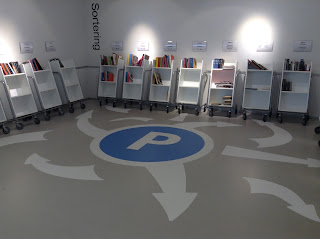
A parking bay for book trolleys!
(Whatever with those Danes think of next?!)

An omnipresent red line creates a literal thread through the library. The is one of the features spawned out of using artists as designers on this project, in conjunction with librarians. Urban sociologists were also called in when the building was established in 2008 to turn this retail area into a third place (as Ray Oldenburg describes them) between work and home. 
The red line leads users along a path around the building...

 ...and it is also used to highlight themes throughout the library!

Most of the library's 5,100 square metres has been designed with families in mind. There are slides hidden within the book stacks and all manner of other miniature play areas for those who are tiny enough to explore and enjoy! There is also a "Very Important Parents" section to relax in and one or two more secluded, quiet spaces for adults too, as well as a 'living room' area with screens showing news feeds, bus timetables and other relevant information.

Another innovative feature I spotted was the use of iPads attached to shelving trolleys - these can, for instance, be pre-loaded up with images and shelfmark details of books for staff to collect from picking lists. Thus making life that little bit easier for everyone!...

Even the staff area is brilliant! Check out the massage chair on the left!!


This library sits inside a larger "Kulturhuset" (culture house), sharing its space with a local archive, museum, an art gallery and performance space. It is a Brutalist building but the imposing concrete structure is skilfully softened through clever lighting and homely finishings around the building.

The children & teenagers' area at Randers


The library also boasts one of the snazziest book sorting units I've seen, complete with mechanical tilting trolleys:


I feel it is a library which perhaps epitomises what the Danes call "Hygge" - a word not easily translatable but is described approximately in this article as a sort of "cosiness of the soul".

A guitar/double bass combo played for us on the main stage!


Dokk1 - Denmark


A brand new, huge publicly funded space on the docks of Aarhus. This library is the largest in Scandinavia (and all of the Nordic countries in fact)  and forms a key part of plans to convert this area of the city from industrial to knowledge space. The aim was to create building to last for 100 years. An important part of that was to create as much flexibility as possible in the space. Everything within the building can be removed easily and it is described as an "intelligent" building, with a Class 1 environmental rating.

 Some 300,000 parts were moved from the old Aarhus library

The expectation is that Dokk1 will receive some 4-5,000 visitors every day!

Described as a "media house", this behemoth occupies some 30,000 square metres, 10,000 of which can be rented out. It is also home to a train station (located underneath one of the main staircases) and an automated car park - essentially an Automated Storage and Retrieval System (ASRS) for cars!


 Hi-tech conference rooms can be adjusted acoustically
according to the type of event happening in these spaces


Large video screens broadcast tweets with the hashtag "#dokk1"

Architects Hammer Lessen set out to create this building with no obvious front or back, with as many open spaces as possible to create opportunities for interactions and knowledge exchange. These include exhibitions, workshops, gaming and events. Immediately outside is the building's "podium" space - an area with climbing frames, slides and other playground apparatus. Rather cutely, these are used to represent the direction in which that particular side of Dokk's 'star' shape the area is pointing towards (the side pointing East to Russia has a large bear, for instance...look in a south-westerly direction towards the US and you'll see a bald eagle!).  


 Designers have included many nods to the city's maritime heritage

Dokk1 includes the largest tubular bell in the world which

rings each time a baby is born at Aarhus hospital!


 It being Denmark, of course there was LEGO!

These have just been some of my personal highlights. To sum it all up  (and without getting too schmaltzy...) nothing gives so much energy, motivation and passion for what I do as the tours I do with Cycling for Libraries. Keeping that going through the relative monotony of life back on 'civvy street', with all of its frustrations, uncertainties and setbacks can sometimes be far more difficult than pushing through kilometre after kilometre of biking. The next tour may well take place outside of Europe for the first time, potentially ending at IFLA 2016 in Ohio! I'll certainly do all I can to be there. 

If you want to see more from the Cycling for Libraries 2015 tour, there is loads of stuff on the www.cyclingforlibraries.org website! We received a lot of media coverage along the route, particularly once we got to Denmark (for instance at one stage a TV cameraman followed us around with his camera on his shoulder as he cycled along with us!). Examples of video reports can be found here (via Kjeld Jensen) and here (via Viborg Folkeblad)

A big thank you has to go to everyone involved in organising the tour, as well as to the sponsors; the seminar we had during our ferry ride between Gothenburg and Fredrikshavn all about skills & competencies required of library & information professionals was especially useful and was kindly funded by DIK, the Swedish professional association and trade union for librarians. A special thank you also goes to Lyngsoe Systems who sent this photo (taken in their backyard!) to all the participants when we got home!
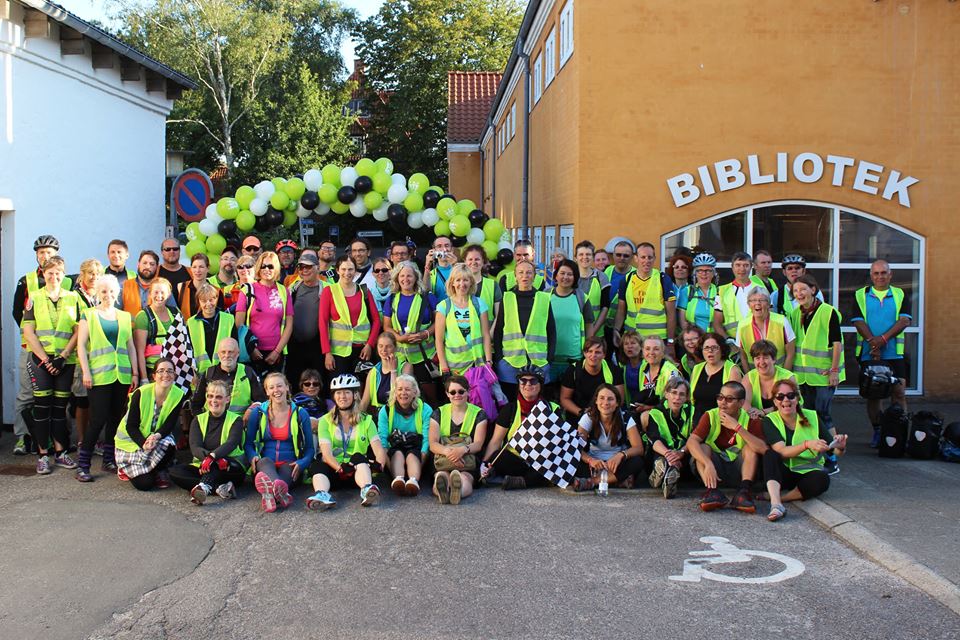

Image reference:

Lyngsoe Systems [via Cycling for Libraries!] (2015) Cyc4lib 2015 tour at the yard of the tour sponsor. Thanks a lot! [Facebook] 25 September. Online at:

Sunday, 27 September 2015

Cycling for Libraries 2015 (part 1)


Cycling for Libraries participants arriving at Aalestrup Library (where we slept over!)


Earlier this month I took part in my 3rd Cycling for Libraries tour. Billed as the "New Nordic Tour", this was definitely the toughest itinerary to date, taking us (a group of over 80 librarians, information professionals and "library lovers" representing over 20 nationalities) some 700+ kilometres across Norway, Sweden and Denmark in 10 hectic days, with plenty of rain, hills and other assorted hardships along the way! 

At certain times...say when you find yourself sleeping in a gym hall surrounded by 40 other people...or creating a human roadblock at night on one of Gothenburg's busiest roads...or playing table-tennis at breaktime during an onboard library workshop whilst crossing from Sweden to Denmark on the ferry, it hits home that Cycling for Libraries is definitely not your ordinary library conference!! But it's an unforgettable experience and one which I would recommend to anyone in libraries (...or at least anyone not averse to a fair bit of physical exertion, I should point out - just as something of a disclaimer!).

It was such an ambitious tour this year that there is no way I'll be able to go through & describe each of the 25+ libraries we visited and all that we did. Some of the themes which pervaded this year's tour though were:

1. Libraries as Meeting Spaces

Each library we visited in Norway included a stage and a platform with audiovisual equipment for speakers to use. This provides a soapbox for campaigners, local politicians and other activists to voice their views and host debates. This is part of a national initiative to encourage discussion in libraries which is now engrained in the Norwegian Library Act (revised January 2014).


Meeting space with sound/projection facilities
at Horten Bibliotek, Norway

At Moss Library, which we visited on the very first day, it was explained to us that libraries of yesteryear are, in effect, "groceries" for selecting information products. These have now been transformed into "chef's kitchens" of collaborative knowledge creation. I rather liked this analogy and this was a transformation we saw replicated throughout Scandinavian libraries.

2. Digital inclusion 

Våga klicka or "Dare to Click" is a large scale project to get some 500,000 digitally disenfranchised Swedish citizens online. One example which we heard about in Uddevalla is 103 year-old Dagny, who learnt her web skills by visiting the library's classes and now authors her own blog - http://www.123minsida.se/Bojan/. It has been incredibly successful, attracting nearly 1,000,000 page views to date! She uses to try and encourage others to join the "blogging party" as she describes it!:

Dagny Carlsson's Blog which has also featured on Swedish national news:

To note that unlike the UK, for example, there is no obligation to provide a library service in Sweden. The idea of a "People's House" where citizens can acquire these sorts of skills is simply engrained in Swedish culture and democracy. 

3. Flattening staffing structures

One of the optional visits in Gothenburg was to Chalmers University of Technology Library where I found a keen emphasis is placed upon space for staff. Yes - it is obviously vital to still prioritise space for users BUT providing areas where staff can thrive too is also important. At Chalmers up to 5 project rooms can be used at once. Each is equipped with the latest technology and ideas are littered all over giant whiteboards across the walls. In this revolutionary setup, projects are decided upon by staff members at all levels and then it is up to management to enable these projects to happen! Examples include a MOOC designed by library staff & a library management system created in-house. Everything the team does online is also made available as open source content.


A project space at Chalmers University Library

We later saw this being replicated at other academic libraries in Sweden & Denmark, for instance Aalborg University where staff generally work on projects for around 2 1/2 months at a time, rather than being in specific team structures. Aars Library in Denmark describes itself as a "spaghetti library" owing to its non-hierarchical structure. 

4.  User Feedback

This tour also highlighted the importance of users being given the opportunity to provide instant and direct feedback. At several libraries, a "hack the library"-style initiative had been tried, with users given ways to show what they liked or disliked about their libraries, then make the changes they wanted to see themselves! Examples include a system of green & red dots used in Vesthimmerlands libraries which the public could disperse around the buildings to highlight the good and bad points of their libraries. Users being given the freedom to reconfigure furniture in most of the libraries we saw is another example of how people are being made to feel engaged with their library services in Scandinavia.

At Aars Bibliotek users and local students
have implemented changes to their library

5. The Danish Model of Library Design 

Denmark does library design well. Astoundingly well, in fact!! I just updated my top ten list of recent library visits and found that no less than 4 of these are Danish libraries! One of the things Denmark has done so well has been to implement the "four space model" in the majority of its libraries. 

The four spaces are inspiration space, learning space, meeting space and performative space. It is a model which is an enduring one to the extent that it has informed the design of libraries far and wide in the 21st Century - examples inspired by the model include some of those I've blogged about previously, for instance Malmö City Library, OBA Amsterdam and the Library of Birmingham.

Danish libraries are also as accessible as possible, with the Open Library system meaning over one-third of the country's libraries can be accessed any time of the day and most of the night via a user's ID card when staff are not there.


I'm actually now feeling kind of knackered just thinking about all we managed to cram into the wild, sometimes frenetic journey that was Cyc4lib 2015 but in part 2 of this blog post I will try to describe some of the amazing libraries we saw along the way!...


Image references: 

Carlsson, D. (2015) BLOGGA MED MIG! (Translation: BLOG WITH ME!). Online at: http://www.123minsida.se/Bojan/ [Accessed 26.09.15]

Vesthimmerlands Biblioteker (2015) TAK FOR BESØGET! (Translation: THANKS FOR THE VISIT!) [Facebook] 9 September. Online at: https://www.facebook.com/VHBIB/timeline [Accessed 26.09.15]

Thursday, 1 August 2013

#cyc4lib Part 2...

Cycling for Libraries Part 2: Reflections

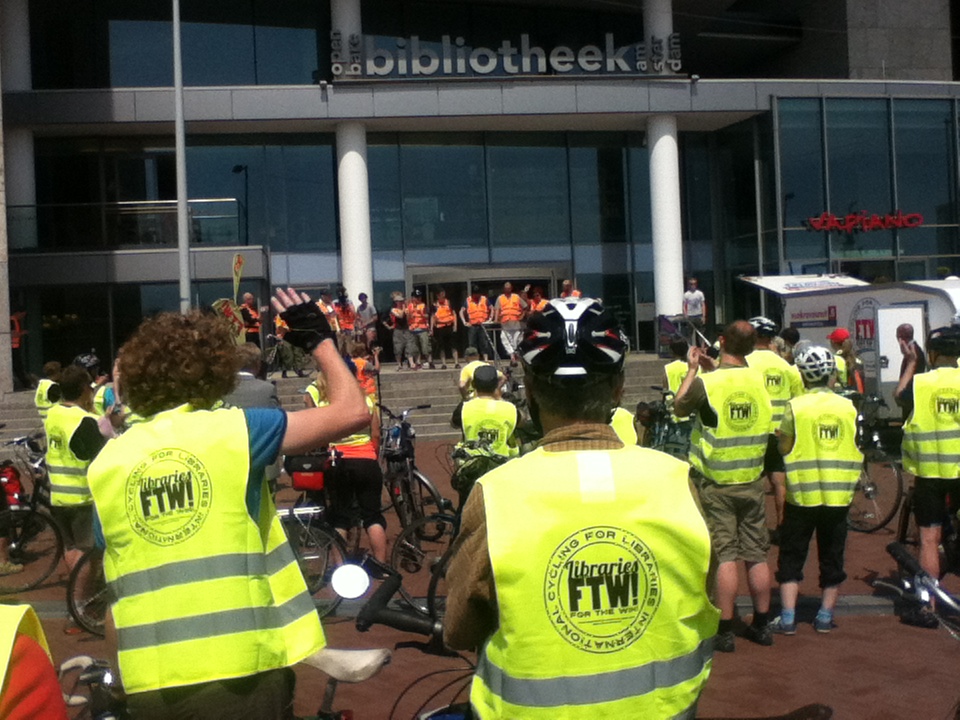
Participants welcomed in Openbare Bibliotheek Amsterdam's
lecture hall at the very start of the Cycling for Libraries tour

I've been home for just over a month now and feel I've had a good chance to reflect on my first Cycling for Libraries tour. Certainly there were some memorable experiences to be had along the way; meeting the World's only Airport librarian, for instance or sampling some of the more unusual Beligan brews (cherry beer, anyone?!) in the many, many library bars! I also got the sense of being part of an something which (although already in its 3rd year) is set to grow even bigger and more ambitious with time. Many participants (a fair few of whom were not library workers themselves) talked about how they felt the trip spurred them to want to step in and help support libraries internationally or to contribute more to the profession. Although pretty exhausted by the end of it all, it was inspiring to see that many others are also prepared to get out there and really do something fantastic in the name of library advocacy too!

One of numerous library bars we visited along the route
The tour also made me think about some key issues within librarianship and about how these are addressed differently in different countries. These are the main points I took away from the experience:

1) Public library  free library


Membership of OpenBare Bibiotheek in Amsterdam
costs €17.50/year & upwards for over 19s
This is something which I'd admit to not having given enough thought to previously. Perhaps because I work in the academic sector, I tend to think of public libraries as places offering free access to information to all. This is not always the case, with subscription fees (albeit affordable charges, in the region of €10 to €20/year for basic membership) being levied on adults for borrowing rights. This was a major point of contention in discussions with Dutch MPs at the Hague, with many library advocates in the Cycling for Libraries group stressing how subscription charges would be unthinkable in countries like the UK or US. Over and above these subscription charges, however, are charges for use of internet access or multimedia resources - and almost all countries have public libraries which charge for these. Are these charges ideologically different from a borrowing charge?..or from charging fines, for that matter (which some would argue amounts to the same thing)?

This certainly gave me a lot to think about. That's even before you get into the great ebook debate and the fact Holland is also the first country to take publishers to court over not being able to lend ebooks from their public libraries. And good on them too!

2. Branding of libraries

Loosely translated, chickens can ask questions about their eggs
...in the library!
Branding seems to be such a pervasive issue in libraries at the moment. Efforts by the Chartered Institute of Library & Information Professionals (CILIP) to rebrand themselves here in UK have made national news, having snowballed into a fierce debate which just rumbles on and on. Quite enough about that already, though.. As you'll be able to see from the list of libraries in my previous post, in many cases in Holland & Belgium, central libraries are now OBA libraries, characterised by their 'living room in the city' appearance with their bright, clean, open spaces. To some extent, walking into these libraries felt like entering an Apple Store or an IKEA but canny designers have added features to give these spaces character of their own. In the brand new Affligem Library, for instance, spaces within the library have been assigned the names of rooms in a house. The story-telling area is enchantingly designated as the 'Attic' for example. For me, at least, these are the kind of ideas which prevent the new breed of libraries from becoming faceless, homogenous buildings and transforming them into something truly out of the ordinary and exciting.

Openbare Dendermonde has an Apple Store-like design
but with enough creative touches to make it unique

3) Open Data presents opportunities for libraries

There are some great things being done with Open Data and we were lucky enough to hear about some of these along the route. In DOK Delft, DOK Lab technicians have made use of library members' address data to send heritage images and information about their own streets direct to their email. Better yet, inside the library there are multi-touch surface installations give users the chance to delve deeper into archives which are relevant specifically to them.


A multi-user interactive table in DOK Deflt allows library members to swipe their
cards to access the history of their personal address through use of Open Data
In a refurbished skate park at DOK Ghent, Pat Hochstenback (Digital Architect at Ghent University Library) told us how open data can be used in even more imaginative ways. He used real-time information about which self-service machines were being used on which level of the library in his code, converting book issues (or circulations) into musical notes, thereby answering the question, "What does a library sound like?":


Whilst the cynic in me noted that some of the things we saw were of questionable use-value (..excepting Pat's example above, obviously!) it is clear that Open Data presents many opportunities for libraries and has the potential to revolutionise users' experiences. Another example we were given in Ghent, for instance, was an award-winning app which lets student's know which is their nearest open pharmacy - illustrating how Open Data mining could even be a potential lifesaver.

4) Libraries should be where people are

There is a real effort in Holland to locate libraries in the busiest spaces. Haarlem Station Library was an example of this which we visited. This was set up to allow people who are waiting for trains during peak hours to have an opportunity to discover books, flick through a magazine or to browse the internet. Any local users with a library card can use the service. It is closely linked to the Schiphol Airport library and similarly has close links with Dutch tourism.

The intention is to open libraries in central stations across Holland, allowing users to borrow a book at one station for their journey and then drop this off at another. This reminded me of the beginnings of WHSmith in the UK, which started as a (subscription-based) book-lending service. Its outlets were located at stations to allow travellers to enjoy the newly available innovation of the paperback book during their train ride.


5) Library folk are universally awesome!

Goes without saying really.. but if ever there was a tour which defied librarian stereotypes and preconceptions then this would be it. As you can see from the participants' profiles, we're an eclectic (/eccentric!) bunch. Everyone seemed to have very different interests, backgrounds and reasons for wanting to take part.

Showing solidarity with libraries which find themselves under threat was an important part of the tour too; no less so than on the very first day, with a visit to the Royal Tropical Institute in Amsterdam. Here we lent our support to staff of Koninklijk Instituut voor de Tropen's (KIT) library whose resource was set to be closed down. Hearing the shocking news that the majority of the 900,000 items comprising this collection were "to be shredded" brought home some of the stark realities which libraries face right now. Whilst we and others tried our best to spread the word about this library (a petition against its closure amassed some 40,000 sigantures) KIT Bibliothek did sadly close, just today in fact - 1st August 2013. On a slightly more positive note, the Institute's website at least states "KIT will make every effort to keep our unique library collection in the future publicly accessible, albeit in a different location". This is of little consolation, however, particularly to those who worked at KIT.


Cycling for Libraries huddled inside the KIT Library
There was also a real spirit of camaraderie throughout the tour as well and everyone we met along the way also went out of their way to make us feel really welcome. This was really appreciated as Cycling for Libraries could definitely be something of an endurance test at times. I don't just mean in terms of the cycling itself here - there was just so much involved.. One minute you find yourself being pelted by hailstones as you fight your way through ferocious crosswinds along dunes on the Dutch coast, the next you're trying to take in a presentation on library architecture or libraries in developing countries..or discussing the future of libraries with MEPs. Suddenly you find it's over a month later and you are trying to make sense of it all!


The "lab guys" at DOK Delft welcomed us in their white coats and
gave an entertaining talk on their work and the future of libraries
Those talented folk Ghent University (UGent) even made this lovely tribute to our ride:


Cycling is a lot like working in a library...

The highlights weren't necessarily the landmarks we saw along the way but some of the  things that happened on route: Returning from lunch at the Hague to discover that Bibliotheek van Haag staff had gone to the trouble of putting saddle covers on all of our bikes to protect them from the rain, for instance.. or the clouds finally parting just as we crossed the Belgian border after some truly horrendous weather.. or random conversations about, say, the actual science behind why we don't have hoverboards (yet!) or how you can take your bike on a van through the Chunnel (I had no idea this service existed!). These are just some of things off the top of my head which have stuck with me for various reasons!


Saddle covers generously provided
by the Library of the Hague
OK, so it was also not all plain sailing along the way, with a fair few scrapes and close shaves (particularly thinking of a very determined motorcyclist on a narrow street in Brussels here who almost ploughed the lot of us down .. grrrr!!). There was a fair amount of taking 'scenic' detours (although we definitely "weren't lost" apparently) and we made do with some pretty 'characterful' accommodation at times too..


This wasn't in the brochure..


..but we made it in one piece and I suspect most of us are probably daft enough to want to do it all again next year. Hope to see you all in Barcelona in August 2014!
Success! We made it to the Grote-Maarkt in Brussels on Day 9


Proudly sporting my hi-vis Cycling for Libraries jacket in the North Sea!