Thursday, 1 August 2013

#cyc4lib Part 2...

Cycling for Libraries Part 2: Reflections

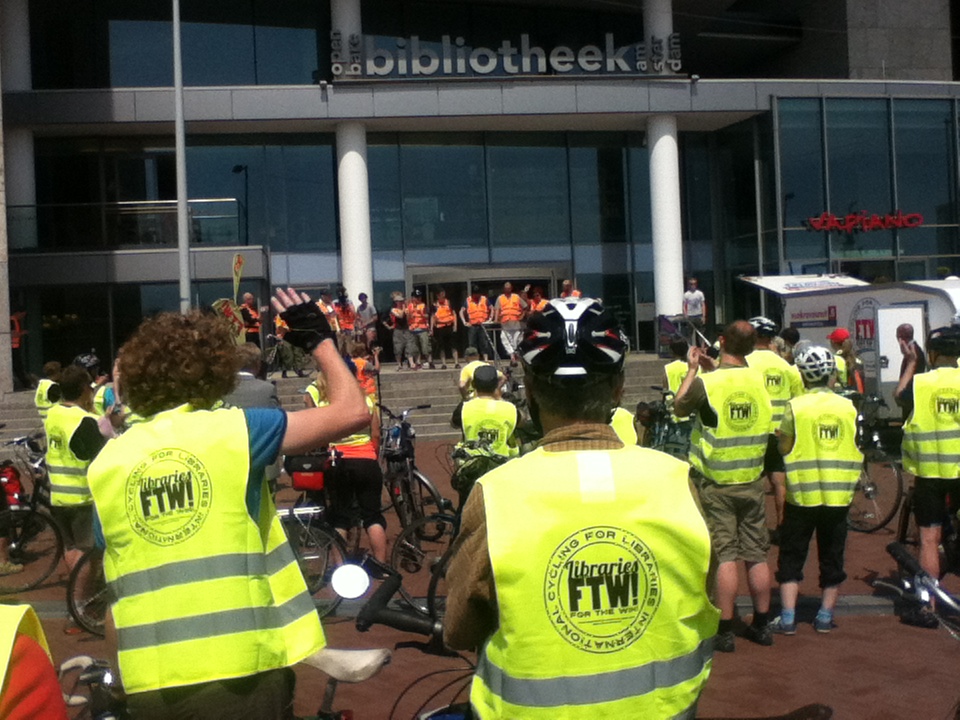
Participants welcomed in Openbare Bibliotheek Amsterdam's
lecture hall at the very start of the Cycling for Libraries tour

I've been home for just over a month now and feel I've had a good chance to reflect on my first Cycling for Libraries tour. Certainly there were some memorable experiences to be had along the way; meeting the World's only Airport librarian, for instance or sampling some of the more unusual Beligan brews (cherry beer, anyone?!) in the many, many library bars! I also got the sense of being part of an something which (although already in its 3rd year) is set to grow even bigger and more ambitious with time. Many participants (a fair few of whom were not library workers themselves) talked about how they felt the trip spurred them to want to step in and help support libraries internationally or to contribute more to the profession. Although pretty exhausted by the end of it all, it was inspiring to see that many others are also prepared to get out there and really do something fantastic in the name of library advocacy too!

One of numerous library bars we visited along the route
The tour also made me think about some key issues within librarianship and about how these are addressed differently in different countries. These are the main points I took away from the experience:

1) Public library  free library


Membership of OpenBare Bibiotheek in Amsterdam
costs €17.50/year & upwards for over 19s
This is something which I'd admit to not having given enough thought to previously. Perhaps because I work in the academic sector, I tend to think of public libraries as places offering free access to information to all. This is not always the case, with subscription fees (albeit affordable charges, in the region of €10 to €20/year for basic membership) being levied on adults for borrowing rights. This was a major point of contention in discussions with Dutch MPs at the Hague, with many library advocates in the Cycling for Libraries group stressing how subscription charges would be unthinkable in countries like the UK or US. Over and above these subscription charges, however, are charges for use of internet access or multimedia resources - and almost all countries have public libraries which charge for these. Are these charges ideologically different from a borrowing charge?..or from charging fines, for that matter (which some would argue amounts to the same thing)?
This certainly gave me a lot to think about. That's even before you get into the great ebook debate and the fact Holland is also the first country to take publishers to court over not being able to lend ebooks from their public libraries. And good on them too!

2. Branding of libraries

Loosely translated, chickens can ask questions about their eggs
...in the library!
Branding seems to be such a pervasive issue in libraries at the moment. Efforts by the Chartered Institute of Library & Information Professionals (CILIP) to rebrand themselves here in UK have made national news, having snowballed into a fierce debate which just rumbles on and on. Quite enough about that already, though.. As you'll be able to see from the list of libraries in my previous post, in many cases in Holland & Belgium, central libraries are now OBA libraries, characterised by their 'living room in the city' appearance with their bright, clean, open spaces. To some extent, walking into these libraries felt like entering an Apple Store or an IKEA but canny designers have added features to give these spaces character of their own. In the brand new Affligem Library, for instance, spaces within the library have been assigned the names of rooms in a house. The story-telling area is enchantingly designated as the 'Attic' for example. For me, at least, these are the kind of ideas which prevent the new breed of libraries from becoming faceless, homogenous buildings and transforming them into something truly out of the ordinary and exciting.

Openbare Dendermonde has an Apple Store-like design
but with enough creative touches to make it unique

3) Open Data presents opportunities for libraries

There are some great things being done with Open Data and we were lucky enough to hear about some of these along the route. In DOK Delft, DOK Lab technicians have made use of library members' address data to send heritage images and information about their own streets direct to their email. Better yet, inside the library there are multi-touch surface installations give users the chance to delve deeper into archives which are relevant specifically to them.


A multi-user interactive table in DOK Deflt allows library members to swipe their
cards to access the history of their personal address through use of Open Data
In a refurbished skate park at DOK Ghent, Pat Hochstenback (Digital Architect at Ghent University Library) told us how open data can be used in even more imaginative ways. He used real-time information about which self-service machines were being used on which level of the library in his code, converting book issues (or circulations) into musical notes, thereby answering the question, "What does a library sound like?":


Whilst the cynic in me noted that some of the things we saw were of questionable use-value (..excepting Pat's example above, obviously!) it is clear that Open Data presents many opportunities for libraries and has the potential to revolutionise users' experiences. Another example we were given in Ghent, for instance, was an award-winning app which lets student's know which is their nearest open pharmacy - illustrating how Open Data mining could even be a potential lifesaver.

4) Libraries should be where people are

There is a real effort in Holland to locate libraries in the busiest spaces. Haarlem Station Library was an example of this which we visited. This was set up to allow people who are waiting for trains during peak hours to have an opportunity to discover books, flick through a magazine or to browse the internet. Any local users with a library card can use the service. It is closely linked to the Schiphol Airport library and similarly has close links with Dutch tourism.

The intention is to open libraries in central stations across Holland, allowing users to borrow a book at one station for their journey and then drop this off at another. This reminded me of the beginnings of WHSmith in the UK, which started as a (subscription-based) book-lending service. Its outlets were located at stations to allow travellers to enjoy the newly available innovation of the paperback book during their train ride.


5) Library folk are universally awesome!

Goes without saying really.. but if ever there was a tour which defied librarian stereotypes and preconceptions then this would be it. As you can see from the participants' profiles, we're an eclectic (/eccentric!) bunch. Everyone seemed to have very different interests, backgrounds and reasons for wanting to take part.

Showing solidarity with libraries which find themselves under threat was an important part of the tour too; no less so than on the very first day, with a visit to the Royal Tropical Institute in Amsterdam. Here we lent our support to staff of Koninklijk Instituut voor de Tropen's (KIT) library whose resource was set to be closed down. Hearing the shocking news that the majority of the 900,000 items comprising this collection were "to be shredded" brought home some of the stark realities which libraries face right now. Whilst we and others tried our best to spread the word about this library (a petition against its closure amassed some 40,000 sigantures) KIT Bibliothek did sadly close, just today in fact - 1st August 2013. On a slightly more positive note, the Institute's website at least states "KIT will make every effort to keep our unique library collection in the future publicly accessible, albeit in a different location". This is of little consolation, however, particularly to those who worked at KIT.


Cycling for Libraries huddled inside the KIT Library
There was also a real spirit of camaraderie throughout the tour as well and everyone we met along the way also went out of their way to make us feel really welcome. This was really appreciated as Cycling for Libraries could definitely be something of an endurance test at times. I don't just mean in terms of the cycling itself here - there was just so much involved.. One minute you find yourself being pelted by hailstones as you fight your way through ferocious crosswinds along dunes on the Dutch coast, the next you're trying to take in a presentation on library architecture or libraries in developing countries..or discussing the future of libraries with MEPs. Suddenly you find it's over a month later and you are trying to make sense of it all!


The "lab guys" at DOK Delft welcomed us in their white coats and
gave an entertaining talk on their work and the future of libraries
Those talented folk Ghent University (UGent) even made this lovely tribute to our ride:


Cycling is a lot like working in a library...

The highlights weren't necessarily the landmarks we saw along the way but some of the  things that happened on route: Returning from lunch at the Hague to discover that Bibliotheek van Haag staff had gone to the trouble of putting saddle covers on all of our bikes to protect them from the rain, for instance.. or the clouds finally parting just as we crossed the Belgian border after some truly horrendous weather.. or random conversations about, say, the actual science behind why we don't have hoverboards (yet!) or how you can take your bike on a van through the Chunnel (I had no idea this service existed!). These are just some of things off the top of my head which have stuck with me for various reasons!


Saddle covers generously provided
by the Library of the Hague
OK, so it was also not all plain sailing along the way, with a fair few scrapes and close shaves (particularly thinking of a very determined motorcyclist on a narrow street in Brussels here who almost ploughed the lot of us down .. grrrr!!). There was a fair amount of taking 'scenic' detours (although we definitely "weren't lost" apparently) and we made do with some pretty 'characterful' accommodation at times too..


This wasn't in the brochure..


..but we made it in one piece and I suspect most of us are probably daft enough to want to do it all again next year. Hope to see you all in Barcelona in August 2014!
Success! We made it to the Grote-Maarkt in Brussels on Day 9


Proudly sporting my hi-vis Cycling for Libraries jacket in the North Sea!

Tuesday, 9 July 2013

Cycling for Libraries...

Part 1. An Overview

Cycling & travel (in the more general sense) are two of the things I enjoy most of all in the world.. along with libraries, obviously.. so when I heard about Cycling for Libraries a few months ago, I immediately decided I'd definitely be signing up for this year's ride!

Some 100 librarians and library lovers from 24 countries set off from Amsterdam on 18 June, arriving at the European Parliament in Brussels to be welcomed by MEPs on 26 June. 


In all, we visited 19 libraries along the route. Here's the full list*:


1. Openbare Bibliotheek Amsterdam (OBA)
Website: http://www.oba.nl/


2. KIT (Koninklijk Instituut voor de Tropen) Tropics Library, Amsterdam
Website: http://www.kit.nl/kit/Royal-Tropical-Institute-


3. Haarlem Stationbibliotheek (Haarlem Railway Station Library)


4. Zandvoort Bibliotheek 


5. Bibliotheek Bollenstreek, Noordwijk 


6. DOK Delft
Website/Catalogue: http://www.dok.info/


7. Techinische Universiteit [TU] Delft (Deflt University Library) 


8. Hoofdbibliotheek Biekorf, Brugge (Bruges Central Library)


9. Openbare Bibliotheek, Oostkamp
Website/Catalogue http://www.oostkamp.be/product/966/bibliotheek-catalogus


10. Zwevegem Bibus (West Flanders Mobile Library)
Website: http://www.zwevegem.be/bibus

(The bus travels around the West Flanders region)
View Larger Map


11. Openbare Bibliotheek Gent (Ghent Central Library)
Website: http://www.gent.be/bibliotheek


12. Universiteitsbibliotheek Boekentoren Gent (Ghent Uni Library/Book Tower)
Website: http://www.boekentoren.be/ 


13. Openbare Bibliotheek, Dendermonde 
Website: http://www.dendermonde.be/bibliotheken/3451/default.aspx?id=1768&rf=1


14. Affligem Monastery Library
Info: http://www.abdijaffligem.be/


15. Affligem Bibliotheek
Website: http://www.affligem.be/Affligem/Nederlands/vrije-tijd/bibliotheek/page.aspx/23


16. Hoofdbilbliotheek Asse


17. Openbare Bibliotheek Sans Souci van Elsene (The Library of Elsene, Ixelles)
Website: http://www.elsene.bibliotheek.be/


18. Muntpunt Library (opening 7 September 2013)
Website: http://www.muntpunt.be/en


19. Library of the European Parliament 
Website: http://www.eurolibnet.eu/3/72/&for=show&tid=7917


*A quick mention too for the 
Bibliothèque Publique Francophone d'Ixelles - our first stop-off point when we got to Brussels. Although we sadly didn't get a chance to pop in, staff very kindly welcomed us outside with some much-needed orange juice! There was also the 
excellent Amsterdam International Community School Library, pictured below, where some of us went for pre-tour drinks the evening before the ride (see www.facebook.com/aicslibrary). 


The International Community School Library, Amsterdam
Apart from these library visits, we also managed to cram in a highly engaging trip to the Hague to discuss the future of libraries with Dutch MPs.. more of which to follow in a future blog post. Among other highlights, we also enjoyed a trip to the seaside, a brisk walking tour of the Dutch model village at Madurodam and a Finnish-style Mid-Summer Party (complete with portable sauna!).

I plan to jot down a few reflections on the tour here on the blog when I can (it's been back to work for me this week, more's the pity..) but the video of the whole journey can be found below in the meantime. There's a plethora of press reports, blogs and articles available here on the Cycling for Libraries site too and I also recommend the detailed write ups of each day which are posted on the Bizologie website. Enjoy! :-)


Wednesday, 17 April 2013

'Quick' Chartership Update (Part 2)...

Some 550 years ago, Rotterdam was the home of Desiderious Erasmus - the Dutch Renaissance Scholar and Humanist who is revered to this day within academia for his efforts in preaching a message of tolerance, freedom of expression and respect for others. Erasmus remains Rotterdam's most famous son and it is a testament to his legacy that Holland's second city is such a chilled-out and culturally diverse place to this day. Rotterdam has become known as the "Gateway to Europe" hosting Europe's busiest port. Whilst the city was practically obliterated during the Second World War, it now also boasts some of the most cutting-edge architecture in the world.


This could be Rotterdam... or anywhere
Rotterdam has many fantastic libraries. The problem nowadays is trying to find them! With 19 of the city's 25 public libraries having closed in recent years, aside from the massive central library (below) it is often hard to pick them out.


Bibliotheek Rotterdam - the central library
attracts some 3.4 million visits per year
What does have to be said, however, is that the central library itself is a captivating (if not downright magnificent) place! In Part 1 of this (inexcusably long) blog post, I wrote about libraries which do things, places which inspire users to want to better themselves and to participate in the activities which they offer. It is a huge building to explore, for a start and from the giant chess board in the foyer (see below - N.B. from what I saw, Rotterdammers are obsessed with chess!) to the music practice rooms on the 6th floor, the library strives to invite users to engage with their surroundings at every step. This idea of a library which is "alive" extends to the living roof, where a bee-hive was installed in 2012 to celebrate 'The Year of the Bee' in Holland!

Chess players and spectators outside the Bibliotheek's Cafe
The music/media area includes access to the Musiekweb database
which offers the choice of some 4.5 million tracks
The Rotterdam suburb of Spijkenisse, a few miles south-west of the city centre, is home to perhaps an even more incredible library building: the so-called 'Book Mountain'. Heralded as "the biggest bookcase in the world", this is a library with a keen focus upon sustainability, with natural lighting used as much as possible, trees lining the pathways and shelving made of recycled plastic bags (I kid you not!). Since opening in October 2012, the building has already been nominated for a raft of international awards, including the Red Dot Design Award (which it won) and the London Design Museum's 'Design Museum of the Year' Architecture Award. 

Again, participation is the key here. The pyramid includes small enclaves which host IT teaching facilities, classrooms, special collections, a gallery and meeting spaces - enticingly hidden within the pyramid. For those intrepid enough to make it to the top, there is also a cafe and (inevitably) more chess!


MVRDV's 'Book Pyramid' in Spijknisse, a suburb of Rotterdam

An entrance into the pyramid leads to a small gallery
hosting an international photography exhibition
Given that (..and possibly because) Rotterdam is host to such facilities as the central Bibliotheek and the Book Pyramid, it is a sad to see that public library provision elsewhere is just so sparse. Some of the city's residents have taken matters into their own hands. I saw an example of this at Rotterdam-West - namely the enchanting Lees Zaal community project:


Lees Zaal is Dutch for 'Reading Room'

Bird box book shelf at Lees Zaal!
It was interesting to get the perspective of those volunteers working in this community facility. They received criticism from some quarters for taking on a role which some view as the responsibility for the Dutch Government to provide. The response of campaigners was to point out that ensuring a community "reading room" of some description was retained in this area was simply too important to get angry about (noticeably, staff do not refer to the project as a library, even though it has an open book collection). The project has secured support from Stichting Doen, a lottery-funded scheme encouraging sustainable community projects and Woonstad Rotterdam, a city-wide housing project. 

Visiting some of Rotterdam's other cultural hubs has convinced me that this is a city which still values its libraries, despite their diminishing numbers. Below are two examples, the first from the Netherlands Architecture Institute (NAI - the outside of which is pictured at the top of this blog post). The second is one I stumbled across whilst exploring the city's art museum:

The NAI Library contains around 60,000 volumes
with a highly international range

The charmingly prefabricated library at
Boijmans, Rotterdam's main art museum